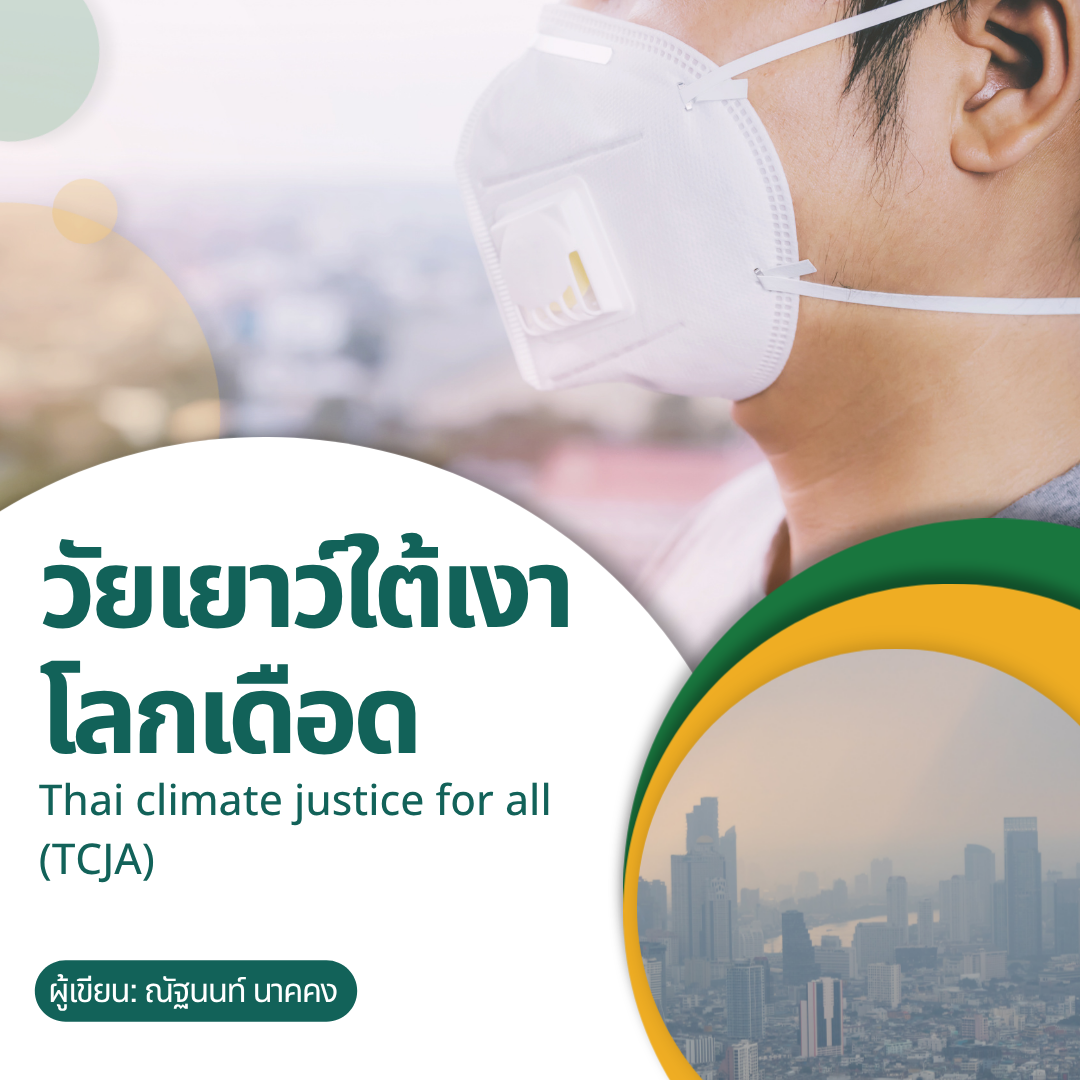


Youth in the shadow of the boiling world
Author: Nattanon Nakkong
Thai climate justice for all (TCJA)
In a world where the seasons are no longer as predictable. A new generation of young children is growing up in a climate that is too hot for their parents’ memories. With heavy rains turning into water, and forests slowly disappearing from the map, climate change is no longer far away. Instead, it became “Atmosphere of life” that gradually seeps through the breath, dreams, and future of a generation silently.
Many young urban children grow up under a dusty sky. PM2.5 They learn to carry masks faster than they can remember the names of street flowers. The sound of air quality alerts on phone screens has become as familiar as the sound of an alarm clock in the morning. The afternoon sunlight reflects off the glass of the tall buildings, making the whole city look suffocated. Beneath the steam from the concrete streets, the big city, which was once imagined as a space of opportunity, It gradually transforms into a space of exhaustion, isolation, and survival.
The extremely hot weather makes the journey longer. Electricity bills go up because air conditioners have to work all night, and when it rains, the concrete-filled city can’t keep up with the drain. People are trapped in the middle of the street, amidst the sound of rain, engines, and red lights reflecting on the waters. Some people just watch the water droplets flow through the car windows, silently questioning why the world, which has developed so far, is still incredibly vulnerable to nature.
Many people have grown up anxious about the climate crisis, worried about whether the world will still be livable in thirty years. Decisions about having a family, choosing a job, or even planning for a long-term life are all overshadowed by the silent question: “What else does the future leave for us?” This feeling is not caused by too sensitivity. Rather, it was due to growing up in an era where disasters became daily news and the world was constantly sounding the alarm, as if every life in the present day was always looming over the shadow of an uncertain future.
Meanwhile, Young people in the countryside face a different kind of crisis. They may not wake up with dust on their mobile screens, but with broken rice paddies. Orchards with reduced yields or rains that come later than the season that I have remembered. The season that was once certain began to be quietly distorted. Some years the rain is too heavy and the crops are damaged. Some years, the drought lasts too long for the land to recover in time. These changes are not limited to the fields. If it continues to gradually erode the stability of people’s lives at the same time.
Many children have to see their parents sitting quietly in front of a pile of invoices. Seeing the tired marks on their sunburned faces, many people choose to travel to the city to find work. Leaving the homeland behind in silence. Such a migration is not just a change of living space. If it also means gradually losing the cultural roots, relationships with the community, and the way of life that used to nourish people’s hearts, and the identity that may never return to the same.
On the other side. Ethnic children and youth are the most vulnerable groups. They live in forest areas. Mountains or marginalized areas that are affected by both climate change and government policies at the same time. When a forest fire occurs, Urban people may only see the smog, but for them, it can mean the loss of farmland, food sources, and homes that have been passed down for generations. If it is still attached to the question of rights. Fairness and Standing in Society
Many communities have been accused of destroying forests. They are people who have been living with nature for a long time. Some children grow up with a sense of self. “Not eligible” Even in the land where our ancestors used to live. This insecurity is exacerbated when natural disasters occur frequently. Forest waters, landslides, or droughts have made life that is already fragile even more shaky. For Ethnic Youth The climate crisis is therefore not just about rising temperatures, but about the struggle for home, memory, and the dignity of existence.
However, in the darkness of the climate change crisis, (climate change) There is still a small movement of the younger generation that is trying to sustain the planet. Some young people in the city have started to come together for an air quality campaign. They use the online and offline space to question the state about dust. PM2.5 Organize Activities To drive the work of the government. These things are quietly changing the way of thinking of our peers and raising their will with all their might: we have not given up on the future.
In rural areas, many people are turning their attention to sustainable agriculture. Experiment with growing your own crops, or build a seed bank in your community to cope with uncertain seasons. Children and youth have become the recorders of the knowledge of the elders, whether it is water management, watching the direction of the wind, or planting native plants that are resistant to climate change. A picture of a child sitting by a fire writing down an elder’s teachings or helping his parents collect seeds. That is an effort to simultaneously preserve food security and sovereignty and community memory.
Meanwhile, many ethnic youth Using “Sound” Defending their homeland through music, photography, writing, and online media. They tell the story of the forest as a home, not a resource, a river as a life, not just an economic number. Some groups mapped communities to assert land rights, others revived traditional rituals that bind humans to nature. In the midst of the hustle and bustle of the modern world. They are reminding that humans are never separated from nature, and that a good future may not always mean leaving the past behind.
Although the efforts of the new generation are still small compared to the power of the state. But the important thing is that they do not succumb to the future. They are turning fear into action. Turning despair into questions, and turning silence into a voice that society is beginning to hear more and more. In a world that makes the younger generation feel that the future is being taken away little by little. Still daring to dream of a better world can be one of the most beautiful forms of resistance.
But we can’t be too romantic about it. They also have to live in the traditional world structure, driven by consumption. Accelerated development and economic benefits Climate Change Crisis Therefore, it is not a burden that young people should bear alone. Rather, it is the shared responsibility of the whole society.
In a world full of wildfires, floods, The one thing that still nourishes people to keep going may be just the little things that are called. “Hope” Although the world may not change immediately, as long as there is a new generation who stands up and takes action, and still believes that the future should be better. Hope is still burning quietly beneath a world that is getting warmer every day, and perhaps it is these small flames that help us still see a common path. In the midst of this uncertain world,
Nattanon Nakkong