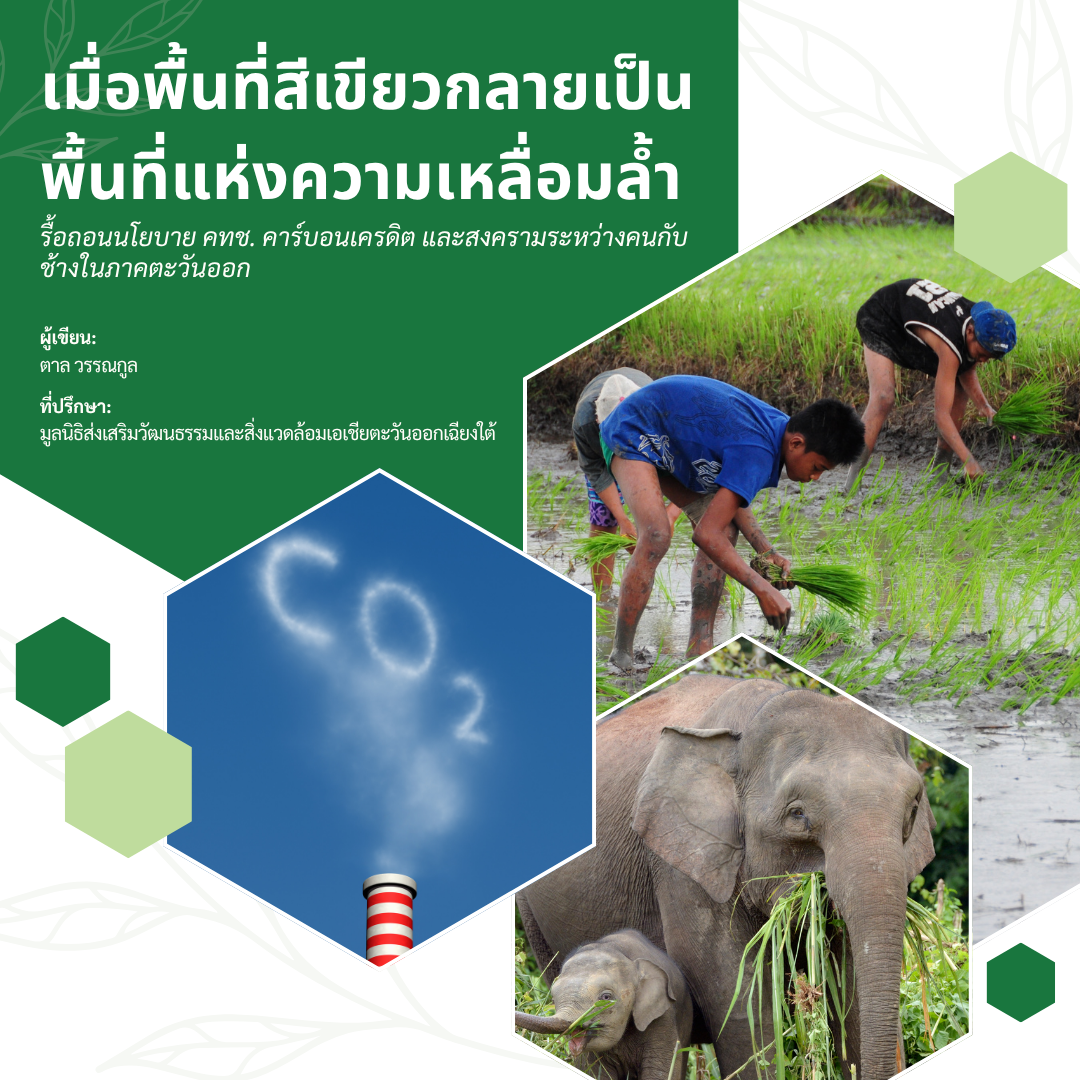


When green space becomes an area of inequality,
Dismantling the NCTC policy. Carbon credits and wars between humans and elephants in the East
Written by: Southeast Asian Culture and Environment Promotion Foundation
Introduction: Green Discourse and Hidden Inequality
In an era when the world is moving towards the goal of Net Zero greenhouse gas emissions, this article raises questions about “Climate Justice”. In the context of Thailand Especially in the eastern region where natural resources are abundant, it has become a battleground for green land grabbing through legal mechanisms and policies that seem to have good intentions.
The article analyzes three main issues that are linked: the National Land Policy Committee (NLPC) policy, the carbon credit project, and the problem of conflict between humans and wild elephants, pointing out that all three issues have common roots in the centralization of state power and the systematic neglect of the rights of local communities.
- NCTC Policy — Land Rights in the Name of Relief
The NCTC was presented as a policy innovation to solve the problem of arable land for the poor, but from a structural point of view, it was found that this system only provides ‘collective farming rights’ without the issuance of individual title deeds or title documents. Villagers in Rayong, Chanthaburi and Trat provinces were frozen to the status of mere ‘beggars’ on land pioneered by their ancestors for centuries, before the first forest law was even enacted.
The impact on human potential is severe. When land does not have a deed, there is no economic value to be used as collateral to access capital sources. Farmers are reluctant to invest in long-term sustainable agriculture because their rights are fragile and can be revoked at any time according to central policies. As a result, many farmers opt for monoculture. Use concentrated chemicals to harvest the benefits as soon as possible. policies that claim to protect the earth force the villagers to indirectly destroy the environment.
Moreover, The government uses satellite and geospatial information (GIS) technology to draw demarcation lines from air-conditioned rooms in Bangkok, ignoring the map in the hearts of the local people. Therefore, the conclusion is that the NCTC It is not a policy to distribute land to the people fairly, but it is a process of organizing land. To prepare an area to support the carbon credit market by having the state as an intermediary in power, negotiating with industrial capital groups on behalf of the villagers.
- Carbon Credits — Conversion of Living Forests into Financial Goods
The growth of the carbon credit market has transformed forests from ‘living spaces’ into tradable ‘carbon storage tanks’ in the global market. Large industrial companies in the Eastern Economic Corridor (EEC) project that emit huge greenhouse gases. Use the reforestation project in the NCTC area. It is a greenwashing tool to ensure that products meet international environmental standards, but the profits from carbon credits are not distributed fairly to the community.
Villagers who have been taking care of the forest for generations have been reduced to just daily wage workers, planting and guarding trees to meet the standards of the voluntary greenhouse gas reduction project according to Thailand’s standards. or the Thailand Voluntary Emission Reduction Program (T-VER) to increase the value of capitalists’ shares, without a share of the revenue from the air over the land they have always maintained. The state has also built a ‘knowledge wall’, claiming that carbon credits require experts and central technology, which systematically and deliberately undermines local wisdom.
The tangible aftermath is to transform forest areas with various species into monocultures. that focus on carbon sequestration but lack biodiversity. Villagers have been restricted from access to forests, lost food and herb sources, and the once-supportive relationship between people and forests has been replaced by estrangement and paranoia. This is a ‘green prison’ that imprisons the community’s opportunities for self-reliance.
- Man-Elephant War — The Neglected Costs of Centralization
The problem of conflicts between humans and wild elephants that has intensified in the forest areas of the five provinces in the eastern region is not a natural phenomenon but a direct consequence of forest management policies. that lacks a holistic view of the ecosystem. When forests are converted into carbon sequestration plant plots, Crop food of wild animals decreases. Therefore, the increasing number of wild elephants must encroach on agricultural land to survive.
The most painful thing is the state’s double standard practice. If the villagers encroach on the forest boundary slightly, they may be punished by law. The state can only express its condolences.
and provide remedies calculated at a rate much lower than the actual cost. The villagers had to sleep guarding the garden every night, losing their mental health, and sometimes losing their lives. To protect land that they do not have stable ownership of.
This problem reflects the failure of the modular administration. The Department of Forestry and the Department of Parks aim to increase green areas and maintain the number of elephants. Economic agencies aim to sell carbon credits to the Eastern Special Development Zone project, but none of them are responsible for looking at the lives of local people holistically.
Conclusion: Towards Climate Justice
The article suggests that the East is becoming a ‘green colony’ where the state and capitalist groups monopolize the virtues and goodness of conservation through the world stage. Meanwhile, the local villagers have to bear the cost of living, including not owning land, having no share in the green economy, and having to face wild elephants alone.
The author proposes that true sustainability must be built on the basis of fairness. The state must return land ownership and resource management authority to the community, allow villagers to have a fair share of the income from carbon credits, and must integrate conservation policies with policies to improve the quality of life holistically so that people, forests, and wild animals can design life paths that can survive together. No one has to bear sins in the name of conservation anymore.